
Paul R. Williams and the LAX Theme Building

The Story Behind One of Los Angeles' Greatest Architectural Icons
Every city has a landmark that instantly communicates its identity. For Paris, it is the Eiffel Tower. For Sydney, the Opera House. For Los Angeles, few structures have represented the city's optimism, innovation, and fascination with the future more powerfully than the iconic Theme Building at Los Angeles International Airport.

For generations of travelers, the soaring white arches and suspended circular observation deck symbolized the excitement of the Jet Age. It was the first and last image millions of visitors associated with Southern California—a bold declaration that Los Angeles was a city looking toward tomorrow.
Few people, however, realize that one of the architects who helped bring this landmark to life was Paul Revere Williams, one of America's greatest architects and the first African American to achieve national prominence in the profession.
A Pioneer Against Extraordinary Odds

Born in Los Angeles in 1894, Paul Revere Williams was orphaned before his fourth birthday and raised by foster parents. During an era when racial discrimination shaped nearly every profession, Williams chose one of the most difficult careers imaginable for an African American: architecture.
Many clients openly admitted they were uncomfortable working with a Black architect. Williams developed remarkable professional habits simply to overcome prejudice. He famously learned to draw upside down across the drafting table so white clients would not have to sit beside him. His extraordinary drafting skills became legendary throughout the architectural community.
Talent eventually overcame prejudice.
Over a career spanning more than five decades, Williams designed more than 3,000 buildings, including luxury residences for Frank Sinatra, Lucille Ball, Barbara Stanwyck, Cary Grant, and countless other Hollywood figures. Yet his work extended far beyond celebrity homes. He designed churches, hospitals, hotels, schools, civic buildings, commercial developments, and public institutions that helped define Southern California throughout the twentieth century.
Creating the Face of the Jet Age
During the 1950s, Los Angeles was rapidly becoming one of the world's aviation capitals. Air travel was expanding dramatically, and the city envisioned an airport unlike any other—a facility that would embody speed, technology, and the optimism of the Space Age.
The airport's master planning brought together an extraordinary collaboration of Southern California architects, including William Pereira, Charles Luckman, Welton Becket, and Paul R. Williams. Their collective work helped transform Los Angeles International Airport into what many considered the world's first true Jet Age airport.
At the heart of that vision stood the Theme Building.
Completed in 1961, the structure was unlike anything the public had ever seen. Two massive white concrete arches appeared to lift a flying saucer into the sky. The building looked less like conventional architecture than something arriving from the future.
Its purpose was never simply functional.
The Theme Building served as a visual statement—an architectural symbol announcing that Los Angeles embraced innovation, aerospace, and modern transportation. The building quickly became one of the city's most photographed landmarks and, alongside the Hollywood Sign, one of its most recognizable images worldwide.
Paul Williams' Role
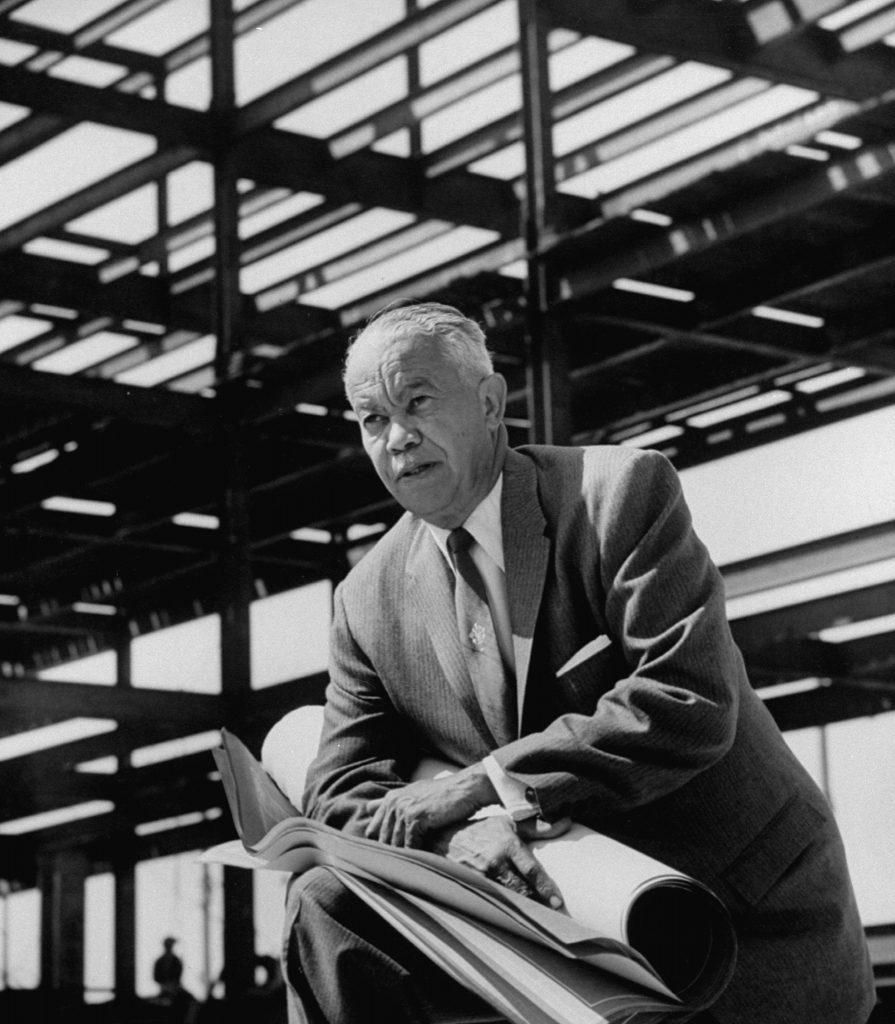
Like many landmark civic projects of the era, the Theme Building emerged from a collaborative team rather than a single designer. Architectural historians continue to discuss the precise division of responsibilities among the participating firms, but there is broad agreement that Paul R. Williams was an important member of the airport's architectural team and contributed to the overall LAX project. Modern histories from Los Angeles institutions and Los Angeles World Airports include Williams among the architects associated with the Theme Building and the Jet Age redevelopment of LAX.
Regardless of which individual sketched which line, the Theme Building stands today as one of the most visible public landmarks associated with Williams' remarkable career.
For many visitors, it also represents something even more meaningful: one of the world's most recognizable architectural landmarks created with the contributions of a pioneering Black architect during an era when such recognition was exceedingly rare.
An Icon That Lost Its Purpose
Ironically, the building's greatest strength eventually became its greatest challenge.
As aviation evolved, airport security requirements expanded, terminals grew, and passenger volumes exploded. The airport transformed around the Theme Building until the futuristic centerpiece that once symbolized the future became increasingly isolated from everyday airport operations.
For decades, visitors could ride an elevator to the observation deck or dine at the famous Encounter Restaurant, enjoying panoramic views of aircraft arriving from around the world.
That experience eventually disappeared.
Structural concerns led to extensive seismic retrofitting, the observation deck closed for long periods, and the restaurant permanently ceased operations. Although the building itself remains standing as an officially protected historic landmark, its original public purpose has largely vanished. Today it serves primarily administrative and support functions while remaining one of Southern California's most recognizable architectural symbols.
As Los Angeles Magazine recently observed in its feature examining the building's history, the Theme Building remains beloved by Angelenos even though most travelers now simply pass beneath it without ever entering the structure. It continues to represent the optimism of an era when architects believed airports could inspire wonder as much as transportation. What Happened to LAX's Staple Theme Building?
A Lasting Legacy
Today, Paul Revere Williams is finally receiving the recognition long denied during much of his career.

His buildings remain woven into the fabric of Southern California—from elegant Beverly Hills estates to civic landmarks, churches, hotels, and one of the world's most recognizable airports.
The LAX Theme Building is more than an architectural curiosity.
It represents an extraordinary period in American history when architecture expressed confidence, imagination, and limitless possibility. It also stands as a lasting reminder that one of the visionaries who helped shape that future was an African American architect whose talent overcame barriers that once seemed impossible to break.
Every traveler who looks up at the soaring white arches of the Theme Building is witnessing not only a masterpiece of Mid-Century Modern design, but also part of the enduring legacy of Paul Revere Williams—a pioneer whose work continues to define the skyline and identity of Los Angeles more than sixty years later.
A Remark from the Compton Chamber of Commerce
Paul R. Williams' story is about far more than architecture. It is a reminder that talent has never been limited by race, opportunity has not always been equally available, and perseverance can change history.
When Williams began his career in the early twentieth century, African Americans faced barriers that extended into nearly every profession. Many talented individuals were denied opportunities not because of their abilities, but because of the color of their skin. Williams encountered those obstacles throughout his career, yet he refused to let prejudice define his future. Instead, he allowed the quality of his work, his professionalism, and his determination to speak for him.
The result is extraordinary. His designs helped shape the skyline of Southern California and contributed to one of Los Angeles' most recognizable landmarks—the iconic Theme Building at Los Angeles International Airport. Millions of people have admired that landmark without ever knowing that one of its distinguished architects was an African American whose achievements helped open doors for generations that followed.
For the young people of Compton, Williams' life offers an enduring lesson. Success is rarely achieved because the path is easy. It is achieved through preparation, discipline, resilience, and a commitment to excellence, even when circumstances are difficult.
History should never be remembered simply to recount injustice. It should also celebrate those who transformed obstacles into opportunity and whose accomplishments continue to benefit all of society.
Paul R. Williams belongs among those pioneers. His legacy reminds us that creativity, character, and determination have the power to overcome barriers and leave a lasting mark on our communities and our nation.
As a Chamber of Commerce committed to strengthening opportunity, encouraging entrepreneurship, and celebrating achievement wherever it is found, we are proud to recognize the remarkable contributions of Paul R. Williams. His story reminds us that the next generation of innovators, architects, engineers, business leaders, and community builders may already be growing up in neighborhoods just like ours.


