Opinion: Should We Really Be Encouraging Children to Play in the Street Again?

A recent news story has reignited a familiar debate: should children once again be encouraged to play ball in residential streets?
For many, the idea evokes fond memories of childhood—pickup baseball games, basketball in the driveway, and neighbors gathering outside on warm evenings. Those memories are worth celebrating. They remind us of a time when communities often felt smaller, slower, and more connected.
But nostalgia alone should not guide today's public policy.
The question is not whether children should play. They absolutely should.
The real question is whether city streets are the right place for it in today's environment.
Communities have changed dramatically over the past several decades. Traffic volumes have increased. Larger vehicles have become the norm. Commercial deliveries, rideshare services, and distracted driving have all become part of everyday life. In cities like Compton, where transportation and logistics are essential components of the local economy, streets serve an important purpose in moving people and commerce safely and efficiently.
At the same time, many communities—including Compton—have invested millions of dollars in modern parks, playgrounds, athletic fields, recreation centers, walking paths, and dedicated sports facilities. These spaces exist for a reason: they provide safer, more suitable environments where children and families can gather, exercise, compete, and enjoy outdoor recreation.
That raises an important question.
If today's communities already offer purpose-built recreational facilities, is encouraging a return to playing in traffic lanes really a step forward?
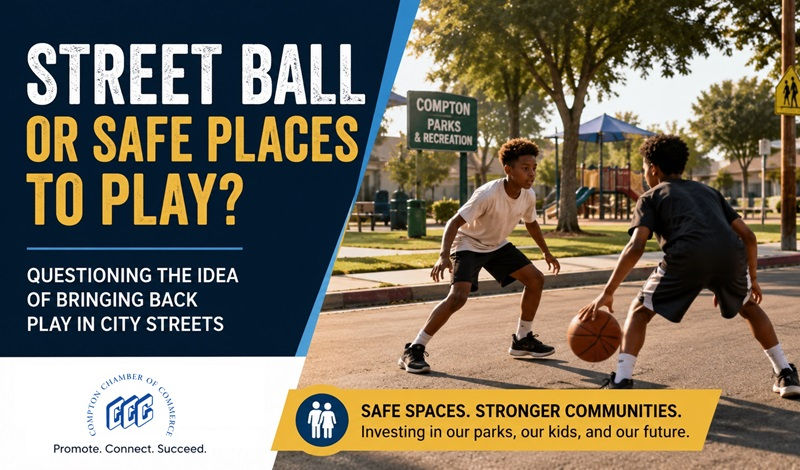
Perhaps our focus should not be on recreating the past, but on making the best possible use of the resources we have today. Parks become vibrant when families use them. Youth sports programs thrive when volunteers coach and parents participate.
Recreation centers become community anchors when residents take advantage of the opportunities they provide.
There is nothing wrong with celebrating the memories many of us have of growing up outdoors. In fact, encouraging children to spend less time on screens and more time being physically active is a goal most people would support.
But there is an important distinction between encouraging outdoor play and encouraging play in places that were never intended to serve as recreational spaces.
Communities evolve. Infrastructure evolves. Public investments evolve.
Perhaps the greatest tribute we can pay to the next generation is not asking them to return to yesterday's streets, but ensuring they fully enjoy today's parks, playgrounds, sports fields, and community facilities—investments that previous generations could only have imagined.
Rather than debating how to bring street ball back, perhaps the better conversation is how we continue building communities where every child has safe, accessible, and inviting places to play.
That is a goal worthy of our attention.
Editor's Note: This opinion was inspired by the recent Los Angeles Times article, "In L.A., playing ball in the streets is a crime. A City Council member wants to change that," published on July 23, 2026. The views expressed here are those of the author and are intended to encourage discussion about how communities can best support safe, active neighborhoods by making full use of today's parks, playgrounds, and recreational facilities.