
DURHAM SCHOOL SERVICES AND CUSD REPORT A SMOOTH START TO THE NEW SCHOOL YEAR

Remember Compton’s $25 Million Electric School Bus Project? Are All 50 Now in Full Service? Who Owns the Resulting Assets?
In a recent company-issued news release, Durham School Services reported that Compton Unified School District’s transportation operation began the 2026–27 school year smoothly following months of route preparation, vehicle maintenance, safety reviews and driver staffing.
Durham also reported that it and CUSD had worked together during the previous year and a half to deploy 50 electric school buses. This important update appears to confirm that all 50 previously announced electric buses have now been delivered or placed into the CUSD transportation operation—not merely the first 25 unveiled in February 2025.
With that milestone now publicly announced, the appropriate next step is a complete public accounting of the project’s funding, legal ownership, deployment and daily use; the disposition of the diesel buses designated for replacement; continuing operating costs; and the measurable benefits delivered to CUSD students and the Compton community.
The Compton Chamber of Commerce recognizes the importance of safe and dependable student transportation. We also recognize that replacing conventional vehicles with new technology is a complex undertaking involving federal grants, manufacturers, private transportation contractors, utility infrastructure and long-term operational planning.
For those very reasons, the public should receive clear information showing how this extraordinarily expensive publicly funded investment was structured, how the vehicles are being used and what measurable results have been achieved in the name of Compton’s children and environmental health.
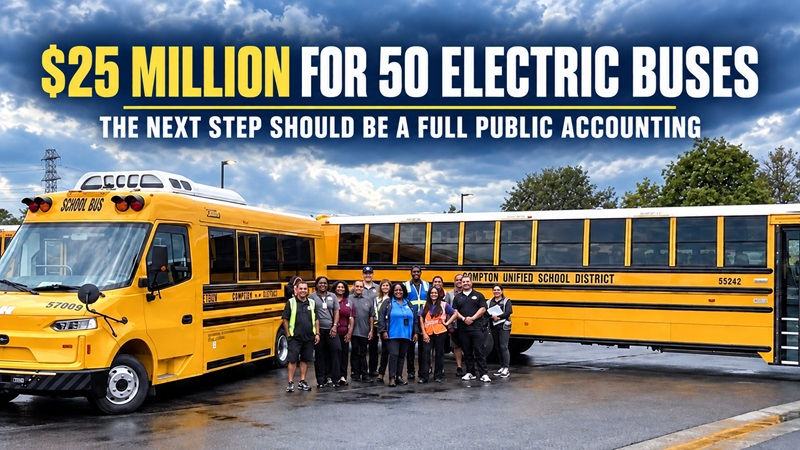
WHO IS DURHAM SCHOOL SERVICES?
Durham School Services is not a department of Compton Unified School District. It is a private student-transportation company contracted to operate CUSD’s school-bus services.
According to Durham, the company and CUSD have maintained their transportation partnership for more than 20 years. Durham’s responsibilities include drivers, monitors, technicians, route preparation, safety procedures, vehicle maintenance and the daily operation of buses serving CUSD students.
The company reports that its entire operating fleet—including all buses serving CUSD—has now been equipped with Samsara fleet-management technology. The technology supports vehicle monitoring and driver-safety coaching.
CUSD Chief Administrative Officer Dr. Shannon Soto credited the preparation, communication and collaboration between the District and Durham with helping students arrive at school safely and reliably at the beginning of the new academic year.
That is a positive operational report. However, Durham’s announcement was prepared by the transportation contractor itself. It was not intended to serve as a financial audit, environmental analysis or independent evaluation of the electric-bus project.
Those additional disclosures must come from the responsible public agencies and project partners.
WHO SECURED THE FEDERAL FUNDING?
The 50 electric buses were financed substantially through two rounds of the U.S. Environmental Protection Agency’s Clean School Bus Program.
For the first 25 buses, Thomas Built Buses submitted the application on behalf of Compton Unified School District. The project received approximately $9.875 million in federal funding through the first round of the EPA program.
That equals approximately $395,000 in federal funding for each of the first 25 buses.
A subsequent application involving Highland Electric Fleets received approximately $8.6 million for another 25 buses serving CUSD.
Together, the publicly identified awards account for approximately:
Federal award | Buses | Amount |
Thomas Built Buses on behalf of CUSD | 25 | $9.875 million |
Highland Electric Fleets project involving CUSD | 25 | $8.6 million |
Total | 50 | $18.475 million |
Therefore, at least $18.475 million of the project was financed through federal taxpayer funding.
The applications may have been administered through manufacturers or private project partners rather than entirely through a conventional CUSD purchasing process. That makes disclosure of the funding structure particularly important.
Federal grant money is still public money. Taxpayers remain entitled to know how it was awarded, who received it, how it was spent and what assets and measurable benefits resulted from the expenditure.
WHO PAID THE REMAINING COSTS?
The complete 50-bus project has been estimated at approximately $25 million.
If approximately $18.475 million came from the two identified federal awards, roughly $6.5 million in additional project value or expense remains to be clearly explained.
That difference may include vehicle costs, charging stations, construction, electrical improvements, utility infrastructure, private financing or other project expenses. Southern California Edison also participated through its transportation-electrification infrastructure program.
The public would benefit from a consolidated financial report identifying:
Total vehicle-acquisition costs
Charging-equipment costs
Electrical and construction expenses
Federal grant funding
State or regional funding
Southern California Edison’s contribution
CUSD’s direct contribution
Durham School Services’ contribution
Highland Electric Fleets’ investment or financing
Annual leasing or service payments
Continuing maintenance obligations
Electricity and demand charges
Battery-replacement responsibilities
The purpose of this inquiry is not to presume that the remaining funds were improperly spent. It is to establish the project’s complete cost and identify which public or private party assumed each financial responsibility.
WHO OWNS THE BUSES AND CHARGING EQUIPMENT?
CUSD previously described the electric vehicles as the school district’s fleet.
Durham’s latest announcement states that the company equipped “its entire fleet, including all CUSD buses” with Samsara technology. That wording may simply reflect Durham’s operational control over the vehicles, but it does not conclusively identify the legal owner.
Highland Electric Fleets specializes in electric-fleet financing, charging infrastructure, ownership and fleet-service arrangements. Thomas Built Buses manufactured the vehicles, while Southern California Edison assisted with the supporting electrical infrastructure.
The legal ownership structure is therefore a reasonable matter for public clarification.
CUSD should identify whether the buses and charging equipment are owned by:
Compton Unified School District
Durham School Services
Highland Electric Fleets
A leasing or financing entity
Some combination of the participating organizations
The public should also know whether CUSD purchased the vehicles outright, leases them, pays a fleet-service charge or will obtain ownership after satisfying contractual conditions.
Ownership determines who controls the assets, who receives their remaining value and who is responsible for insurance, maintenance, battery replacement and eventual disposal.
When approximately $18.5 million in federal taxpayer funding helps create a fleet of new vehicles, identifying the legal owner is a basic element of public accountability.
ARE ALL 50 BUSES NOW IN REGULAR SERVICE?
Durham reports that 50 electric school buses have been “deployed.”
That appears to confirm that the full fleet has arrived or entered the CUSD transportation operation. However, deployment does not necessarily establish that every vehicle is assigned to a regular route and operating each school day.
The announcement does not provide:
The average number of electric buses operating daily
The number assigned to regular routes
The number maintained as reserve vehicles
The routes and distances they cover
The number of students transported
Total mileage accumulated
Vehicle availability and downtime
Charging time and charger reliability
The continued use of diesel buses
The number of electric buses available for athletic or extended trips
These figures would allow the community to understand how extensively the vehicles are being used and whether the fleet is performing as intended.
If all 50 buses are operating successfully, publishing this information would strengthen public confidence in the project.
WHAT HAPPENED TO THE REPLACED DIESEL BUSES?
The EPA Clean School Bus Program was designed to replace older diesel buses—not merely add electric vehicles to an existing fleet.
Under applicable EPA requirements, qualifying older diesel buses generally must be permanently disabled. The established scrappage process may include drilling through the engine block and cutting completely through the chassis or frame rails, followed by photographic and documentary proof.
These requirements prevent a publicly funded replacement program from simply relocating an older diesel bus and its emissions to another community.
Neither CUSD nor Durham has publicly identified the diesel buses associated with the 50 electric replacements. The available announcements do not provide their model years, mileage, vehicle-identification numbers, ownership records or disposal certifications.
A complete report should explain:
Which diesel buses were designated for replacement
Whether CUSD, Durham or another entity owned them
When each bus was removed from regular service
Whether each bus was destroyed, sold, transferred or retained
Whether any permitted sale generated proceeds
How those proceeds were handled
Whether the required EPA documentation was completed
Whether any diesel buses remain available as backups
This is a request for verification—not an allegation that the requirements were violated.
If 50 qualifying diesel buses were properly and permanently removed from service, disclosure of the records would confirm that an essential condition of the publicly funded replacement program was satisfied.
HOW DOES THE COST COMPARE WITH MODERN DIESEL BUSES?
The estimated $25 million project represents an average cost of approximately $500,000 for each of the 50 electric buses, although that figure may include charging and infrastructure expenses.
For comparison, a new full-size diesel school bus equipped with modern emissions controls, air conditioning, safety cameras, GPS and other current technology would generally cost approximately $140,000 to $200,000, depending on its capacity and specifications.
Based on those estimates:
50-bus purchase comparison | Estimated cost |
Modern diesel buses at $140,000 each | $7 million |
High-specification diesel buses at $175,000 each | $8.75 million |
Modern diesel buses at $200,000 each | $10 million |
Estimated electric-bus project | Approximately $25 million |
Additional electric-project cost | Approximately $15 million to $18 million |
Using a middle estimate of $175,000 for a high-specification diesel bus, 50 comparable vehicles would cost approximately $8.75 million.
That is approximately $16.25 million less than the estimated electric-project cost.
On that basis, the electric project may have cost approximately 2.5 to 3.6 times as much as purchasing 50 comparable modern diesel buses.
Purchase price alone does not determine long-term value. Electric buses may produce savings through reduced fuel use and certain maintenance expenses. A responsible comparison must therefore consider the entire useful life of both types of vehicles.
CUSD and its partners should disclose:
Actual electricity costs
Avoided diesel-fuel expenses
Routine maintenance costs
Charger maintenance and availability
Specialized training expenses
Vehicle downtime
Battery warranties
Expected battery-replacement costs
Expected service life
Annual savings achieved to date
The projected break-even period
Without these figures, the public cannot determine whether operating savings will eventually recover the electric project’s estimated $15 million to $18 million initial premium.
WHAT MEASURABLE BENEFIT DID STUDENTS RECEIVE?
This is the most important part of the inquiry.
The electric buses produce no tailpipe emissions while operating and are quieter than diesel buses. Those are genuine characteristics of the vehicles.
However, the public has not yet received evidence demonstrating how those characteristics translated into measurable benefits for CUSD students.
No publicly available project report has identified:
Before-and-after air-quality measurements
In-cabin pollution measurements
Student respiratory-health outcomes
Changes in asthma-related absences
Verified reductions in student exposure
Improvements in attendance or academic performance
Total annual emissions avoided
Cost per ton of emissions eliminated
Independently reviewed environmental results
Compton remains surrounded by an enormous volume of freeway traffic, diesel-powered freight trucks, rail operations, warehouses and industrial pollution sources.
Against that regional emissions burden, the tailpipe emissions avoided by replacing 50 school buses may be difficult to detect in community-wide air-quality measurements. If measurable local improvements have been recorded, CUSD should publish them.
The purpose of asking is not to deny that electric buses have environmental advantages. It is to determine whether those advantages produced a benefit proportionate to the extraordinary public investment made in Compton.
PUBLIC RECOGNITION IS NOT THE SAME AS MEASURABLE PUBLIC BENEFIT
The project has produced substantial visibility.
CUSD officials can point to a major federal investment in new technology. Durham School Services and Highland Electric Fleets can highlight the project as an example of successful fleet electrification. Manufacturers, utility partners and federal officials can cite the deployment as progress toward their environmental objectives.
Such recognition has political and institutional value.
But political credit, corporate publicity and sustainability branding are not substitutes for a cost-benefit analysis.
The essential question is not whether the project generated favorable announcements. It is whether the expenditure produced verifiable financial, operational, environmental and educational value for the children and taxpayers of Compton.
THE CHAMBER’S REQUEST FOR TRANSPARENCY
The Compton Chamber of Commerce respectfully encourages CUSD and its project partners to publish a comprehensive report addressing:
Who initiated, prepared and authorized each grant application
Thomas Built Buses’ role in securing the first $9.875 million
Highland Electric Fleets’ role in securing the subsequent $8.6 million
Every federal, state, utility, District and private contribution
The recipient and use of each funding award
The total project cost
The legal ownership of the buses and charging equipment
All lease, service, financing and maintenance obligations
The number of buses operating on regular daily routes
Total mileage, ridership, availability and downtime
Every diesel bus designated for replacement
The disposal or scrappage record for each replaced vehicle
Actual electricity, charging and maintenance expenses
Battery warranties and replacement responsibilities
Projected and verified operating savings
Measurable student-health and environmental outcomes
Taxpayers financed this project, whether the money came through CUSD, a manufacturer, a private fleet contractor, a utility or the federal government.
Compton residents are entitled to know who secured the funding, who received it, who owns the resulting assets, what happened to the replaced diesel buses, what continuing costs remain and what measurable benefit Compton’s children received.
Cleaner technology may be a desirable objective. Transparent accounting will help the public determine whether this particular investment achieved that objective efficiently and whether its benefits justify its substantial cost.
This is not skepticism for its own sake.
It is a reasonable request for facts, documentation and accountability concerning approximately $25 million spent in the name of Compton’s students and community.
Read Durham School Services’ announcement:
