
California's Diesel Price Problem

Looking Beyond Global Headlines to the Costs Created at Home: Why California's fuel regulations, shrinking refinery capacity, and growing dependence on imported petroleum products matter to Southern California businesses and consumers
When diesel prices rise, public attention frequently turns to international conflicts, crude oil markets, and geopolitical uncertainty. Those developments can influence petroleum prices, but they do not fully explain why California businesses and consumers consistently pay substantially more for diesel than their counterparts in other states.
California has developed a petroleum market with its own fuel specifications, regulatory costs, refining infrastructure, and supply arrangements. These conditions existed long before the latest international tensions and will remain after those tensions subside.
For Southern California, particularly the freight, warehousing, manufacturing, and distribution industries surrounding Compton and the Alameda Corridor, understanding these structural costs is essential.
The central question is not simply why diesel prices are rising nationally. It is why California has made itself a more expensive and less flexible market for an essential transportation fuel.
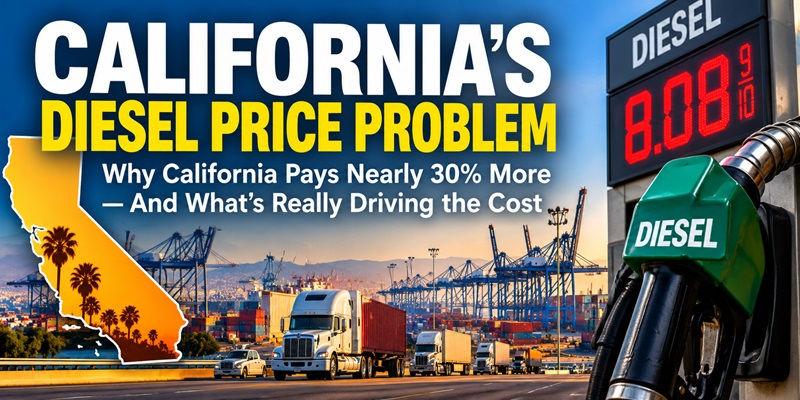
California Diesel Prices: What the Numbers Show
According to the U.S. Energy Information Administration's weekly retail fuel survey for October 5, 2026, average on-highway diesel prices were:
Region | Price per gallon |
California | $8.082 |
United States | $6.199 |
Gulf Coast | $5.819 |
West Coast excluding California | $6.490 |
California diesel was approximately 30.4% more expensive than the national average, representing an additional $1.88 per gallon.
Even compared with other West Coast states, California motorists and commercial operators paid approximately $1.59 more per gallon.
These differences deserve examination because all these regions operate within the same national economy and are exposed, to varying degrees, to international petroleum markets.
The California premium cannot be explained solely by international events affecting crude oil or diesel prices. State-specific factors also contribute to the difference.
Importantly, the 30.4% premium is not a calculation of the cost of California regulations alone. It includes differences in taxes, refining economics, fuel specifications, distribution costs, and market conditions.
California Requires a Different Diesel Fuel
California imposes diesel fuel specifications through the California Air Resources Board (CARB) that go beyond the federal standards applicable across most of the United States.
Federal ultra-low-sulfur diesel is generally limited to 15 parts per million of sulfur. California applies that same sulfur limit but also maintains additional emissions-related fuel requirements.
Under California's prescriptive diesel formulation, aromatic hydrocarbon content is generally limited to 10% by volume, alongside a minimum cetane number of 48. Refiners may also use approved alternative formulations that demonstrate equivalent emissions performance.
The distinction has substantial commercial consequences.
Diesel that is perfectly legal for highway use in any other US state is not eligible for sale in California.
A refinery producing federally compliant diesel for Texas, Arizona, or another state cannot necessarily redirect that product to California without meeting the state's additional requirements.
California's rules therefore narrow the range of immediately interchangeable fuel supplies.
These standards were adopted to reduce harmful vehicle emissions, particularly in areas struggling with air pollution. Their environmental purpose is important. However, the economic costs and supply restrictions they create must also be considered.
The policy question is whether the emissions benefits continue to justify the additional fuel costs and supply constraints imposed on California's economy.
California's Refining Capacity Is Shrinking
Southern California is not a region without petroleum refining infrastructure.
The Los Angeles Basin contains several major facilities capable of producing California-compliant diesel, including:
Marathon Petroleum's Los Angeles refinery complex in Carson and Wilmington.
Chevron's El Segundo refinery.
PBF Energy's Torrance refinery.
Valero's Wilmington refinery.
Together, these facilities represent approximately 879,000 barrels per day of crude oil processing capacity, according to the California Energy Commission's July 2026 refinery inventory.
That figure represents total crude-processing capacity, not the amount of diesel produced daily.
These refineries have historically supported a substantial portion of California's transportation-fuel needs.
However, California's refining industry is contracting.
The Phillips 66 Los Angeles refinery closed in 2025, while Valero ceased refining operations at its Benicia facility in Northern California in April 2026.
The loss of refining capacity matters because diesel demand does not disappear when a refinery closes. Businesses still need to move freight. Farmers still need to operate equipment. Construction companies still require fuel. Grocery stores still depend on transportation and distribution networks.
When local production capacity declines, replacement supplies must come from remaining refineries, inventories, or outside markets. That makes the cost and reliability of replacement fuel increasingly important.
The Growing Dependence on Imported Fuel
California has long operated differently from states connected to the major petroleum pipeline systems serving the Gulf Coast and Midwest. There is no direct refined-product pipeline connecting California to the Gulf Coast refining network. That is not only a physical infrastructure limitation, but California's specialized fuel requirements introduce an additional regulatory restriction.
California does not accept available shipment of federally compliant diesel. Replacement fuel intended for California highway use must satisfy California's requirements.
As refinery capacity declines, the state becomes more dependent on suppliers capable of providing compatible fuel, including refineries outside California and overseas.
Foreign refiners can manufacture or blend diesel to California specifications, but doing so introduces additional commercial considerations:
Availability of compatible fuel production.
Marine transportation and terminal handling.
Shipping schedules and delivery times.
Refinery production and blending costs.
Competition for compatible fuel from other buyers.
These expenses make every imported gallon more expensive than domestically produced fuel. Importing specialized fuel creates a more complicated replacement-supply system than purchasing readily available, federally compliant diesel from a broad domestic market.
California's policy choices have helped create a market in which the state restricts the fuels it can accept while becoming increasingly dependent on outside suppliers capable of meeting those restrictions.
That is a structural vulnerability, not merely a temporary geopolitical problem.
Higher Prices Do Not Automatically Mean a Physical Diesel Shortage
One of the most important distinctions in evaluating California's diesel situation is the difference between expensive fuel and unavailable fuel. A sharp increase in diesel prices does not, by itself, demonstrate that truck stops, fuel terminals, or commercial fleet operators are running out of diesel. Prices increase because of refinery margins, supply expectations, transportation expenses, regulatory costs, or the price refiners must pay for replacement products.
California's petroleum market can therefore experience significant price increases without a widespread interruption in physical deliveries.
The California Energy Commission publishes weekly refinery production and inventory figures, including data for CARB-compliant diesel. Those records provide a more useful starting point for examining physical supply than treating retail price increases as proof of a shortage.
The distinction also matters when evaluating explanations involving foreign conflicts.
International disruptions can influence crude oil prices and refined-product trading. Damage to Russian refining facilities, for example, can affect international diesel production and export availability.
But identifying an international event is not the same as demonstrating how much that event contributed to the price paid by a Southern California trucking company. A credible explanation should separate the international price of petroleum products from California's additional state-specific costs.
California's Fuel Policies Have Economic Consequences Beyond the Pump
Diesel is a major operating expense throughout Southern California's economy.
The Ports of Los Angeles and Long Beach support an extensive network of trucking companies, distribution centers, warehouses, manufacturers, wholesalers, and commercial service providers. Compton occupies an important position within that regional network. Its proximity to the Alameda Corridor, major freeways, port-related freight operations, and industrial districts makes transportation costs particularly relevant to the local business community.
Consider a hypothetical trucking company operating 50 diesel-powered trucks, each traveling 80,000 miles annually at an average fuel economy of 6.5 miles per gallon.
That fleet would consume approximately 615,385 gallons of diesel annually.
An additional $1 per gallon would increase its gross annual fuel expense by approximately $615,000. At a $1.88-per-gallon difference, the additional expense would exceed $1.15 million annually.
These figures illustrate fuel-cost sensitivity rather than the actual costs of a particular Compton company. They also do not account for fleet discounts, fuel surcharges, or contractual reimbursements.
Nevertheless, they demonstrate why fuel prices matter to commercial transportation.
Some businesses can pass higher fuel expenses to customers. Others operate under contracts that limit their ability to recover those costs immediately.
Higher transportation expenses can ultimately affect wholesale prices, food distribution, construction materials, retail merchandise, and consumer services. The economic effects extend well beyond the trucking industry itself.
Environmental Objectives and Economic Competitiveness Must Be Evaluated Together
California's fuel standards were developed to address legitimate air-quality concerns, including emissions from diesel engines. Southern California communities near freeways, industrial facilities, and freight corridors have historically experienced substantial pollution burdens. Reducing harmful emissions remains an important public objective.
However, environmental benefits and economic costs are not mutually exclusive subjects. Responsible public policy requires evaluating both. California's additional diesel requirements can reduce emissions while also restricting supply flexibility and increasing compliance costs.
Refinery closures may reduce local industrial emissions, but replacement petroleum products still have to be manufactured somewhere. Imported fuel also require longer transportation routes. That raises legitimate questions about the total environmental and economic consequences of shifting production outside California.
It is also important to distinguish conventional diesel specifications from other California policies, including fuel taxes, the Low Carbon Fuel Standard, and the state's broader emissions-reduction programs. These policies affect costs through different mechanisms and should not be combined into a single unsupported estimate.
The appropriate evaluation is not whether environmental protection matters. It is whether California's existing approach delivers measurable benefits at a cost that businesses and consumers can reasonably sustain.
What California Should Be Asking
Rather than relying primarily on international headlines to explain diesel price increases, California policymakers should provide clearer answers to several practical questions.
How much of California's diesel price premium comes from state fuel specifications, taxes, regulatory programs, refinery margins, and distribution costs?
How much CARB-compliant diesel is produced within California, and how much is imported?
What are the economic consequences of additional refinery closures?
Could alternative compliance arrangements preserve necessary air-quality protections while expanding the number of eligible fuel suppliers?
And how will the state protect transportation-dependent businesses from escalating costs while maintaining reliable fuel supplies?
These are measurable policy questions.
Answering them requires transparent production figures, import data, price comparisons, and independent evaluation of regulatory costs and benefits.
The Bottom Line for Southern California
California's diesel prices cannot be understood simply by pointing to international conflicts or changes in global crude oil prices. Those developments may influence the broader petroleum market, but California's persistent price premium reflects structural conditions within the state itself.
California requires specialized diesel formulations, operates with declining refining capacity, lacks direct pipeline connections to major domestic refining regions, and increasingly relies on compatible fuel supplied from outside the state.
Each of these conditions affects the flexibility and economics of California's fuel market.
For Compton and the surrounding logistics economy, the consequences are practical: higher operating expenses, pressure on transportation rates, and higher costs for businesses and consumers.
The essential issue is not whether California should protect its air quality. It is whether the state can achieve those protections without unnecessarily restricting fuel availability, discouraging refining investment, and placing its businesses at a sustained competitive disadvantage.
That question deserves a serious examination grounded in California's own fuel-production, import, regulatory, and pricing data—not an explanation that begins and ends with the latest international crisis.


